How a Suppressor Actually Works — and Why a .30 Cal Can Is Plenty for 5.56
Heat, gas, and sound, start to finish: what happens in the first two milliseconds after the bullet leaves the bore, and why one .30 caliber can covers your 5.56 too.
Native Industries ·
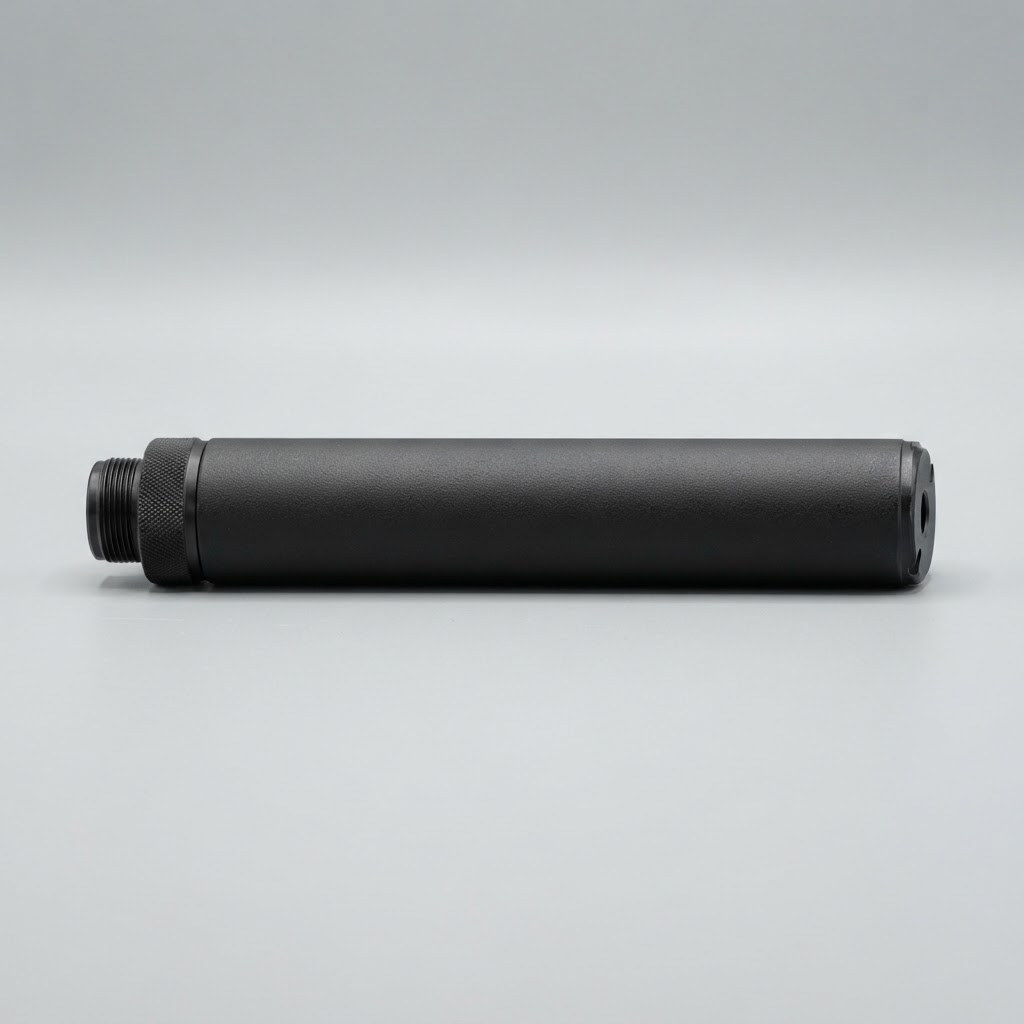
A suppressor is not a muffler for the bullet. It is a pressure vessel for the gas behind it. Once you see it that way, everything else — why cans get hot, why the first shot is louder, why a bigger bore can work on a smaller rifle — falls into place.
The mechanics. When powder burns, it turns a few grains of solid into a large volume of gas at very high pressure. That gas drives the bullet down the barrel. When the bullet leaves the muzzle, the gas behind it is still at several thousand psi and somewhere around 1,500 to 2,000 degrees Fahrenheit. Without a can, it dumps into open air all at once. That sudden pressure release is the muzzle blast — most of what you hear, and most of what damages your ears.
Gas dynamics. A suppressor gives that gas somewhere to go before it reaches the air. First the blast chamber: an open space right off the muzzle where gas expands, slows, and drops in pressure. Then the baffles: a stack of cones or K- and M-shaped dividers with a hole just bigger than the bullet. The bullet goes straight through. The gas does not — it is forced to swirl, turn, and fill each chamber in turn. Every turn costs it speed and pressure. By the time it leaves the end cap, it is coming out over a longer stretch of time at far lower pressure. Same energy, released slower. Your ear hears that as quieter.
Thermal dynamics. The energy has to go somewhere, and most of it turns into heat in the baffles and tube. That is why a can goes from cool to too-hot-to-touch in a few magazines, and why material matters. Stainless and Inconel handle high-pressure rifle blast and long strings well. Titanium is lighter but less tolerant of heat and erosion, especially on short barrels. Aluminum belongs on rimfire and some pistol cans. Heat also changes the can as you shoot: hot gas is thinner, so a hot suppressor often sounds a little different than a cold one. Heat mirage coming off the tube can blur your scope picture — a cover helps.
First-round pop. The first shot through a cold, empty can is usually louder. The can is full of ordinary air with oxygen in it, and unburned powder burns off in it with a small flash. After that shot, the can is full of spent gas with little oxygen left, and the next shots are quieter. Plan for it on a hunt: your first shot is the one that matters, and it is the loudest one.
Sound. A suppressor attacks one source of noise. It does nothing about the others. An unsuppressed 5.56 is around 165 decibels at the shooter's ear. A good can brings that into the low-to-mid 130s. That is a big drop — the difference between instant hearing damage and an uncomfortable bang — but it is not silent and not truly hearing safe. The bullet itself is supersonic and makes its own crack all the way downrange, which no can can touch. The action, the bolt, and the target all make noise too. Suppressed hunting still means ear protection for anyone standing near the rifle in a blind.
Why a .30 cal can works on 5.56. A .30 caliber suppressor has a bore around .30 to .32 inch through its baffles. A 5.56 bullet is .224. That extra gap means a little more gas slips straight through instead of being forced through the chambers, so it is somewhat louder — usually only a couple of decibels in practice, and many shooters cannot hear the difference. In exchange, you get real advantages. More clearance means much less chance of a baffle strike if anything is slightly out of line. The bigger volume handles 5.56 gas comfortably. And one can now covers your .223, .300 Blackout, 6.5 Creedmoor, and .308 — one tax stamp, one wait, one suppressor moved between rifles.
What you must check first. The can has to be rated for the cartridge and the barrel length. 5.56 is a high-pressure, high-heat round, and short barrels make it worse. Some .30 cans have a minimum barrel length on 5.56, or are not rated for full-auto or long strings. Read the maker's rating before you mount it. Match the thread pitch — most 5.56 barrels are 1/2-28 and most .30 cans expect 5/8-24, so you will need the correct mount or adapter, installed and checked for concentricity. And if you will only ever run 5.56, a dedicated 5.56 can will be shorter, lighter, and slightly quieter.
The fit question. If you own one rifle and it is a 5.56, buy a 5.56 can. If you hunt with more than one rifle, or you think you might step up to a .30 later, a .30 cal can is the smarter first suppressor for most people. Bring us your rifle list and we will check ratings, mounts, and barrel lengths before you file a single form.