Opening Day North of the Border
Five Texas boys, a thatch-wrapped trailer blind, and a stubble field full of snows and blues. The part they don't put in the brochure.
Adventures from East Texas ·
The alarm goes off at three in the morning, but out here nobody needs it. Half the truck has been awake since two, running thermoses and checking the weather app for a wind direction that hasn't changed in a week. It's opening day, and we're a long way north of the Red River, standing in a stubble field that stretches flat as a tablecloth to a wall of poplar just starting to turn gold.
This is the part they don't put in the brochure. The part where five grown men crawl out of a warm truck in the dark and spend the next hour setting a spread that has to be exactly right — not good enough, right — before a single bird ever shows up.
Our blind is a trailer wrapped in thatch, a rolling hay bale on tandem axles that looks like part of the field itself. From the road you'd never see it. From the air, the geese don't either. That's the whole trick of it: we are not hiding from the birds. We are trying to become the field.
The trucks — a black GMC Sierra with a cap, the trailer hunkered behind it — sit at the edge of the spread like part of the landscape. Nobody polishes a rig that's about to spend its weekend pretending to be a ditch.
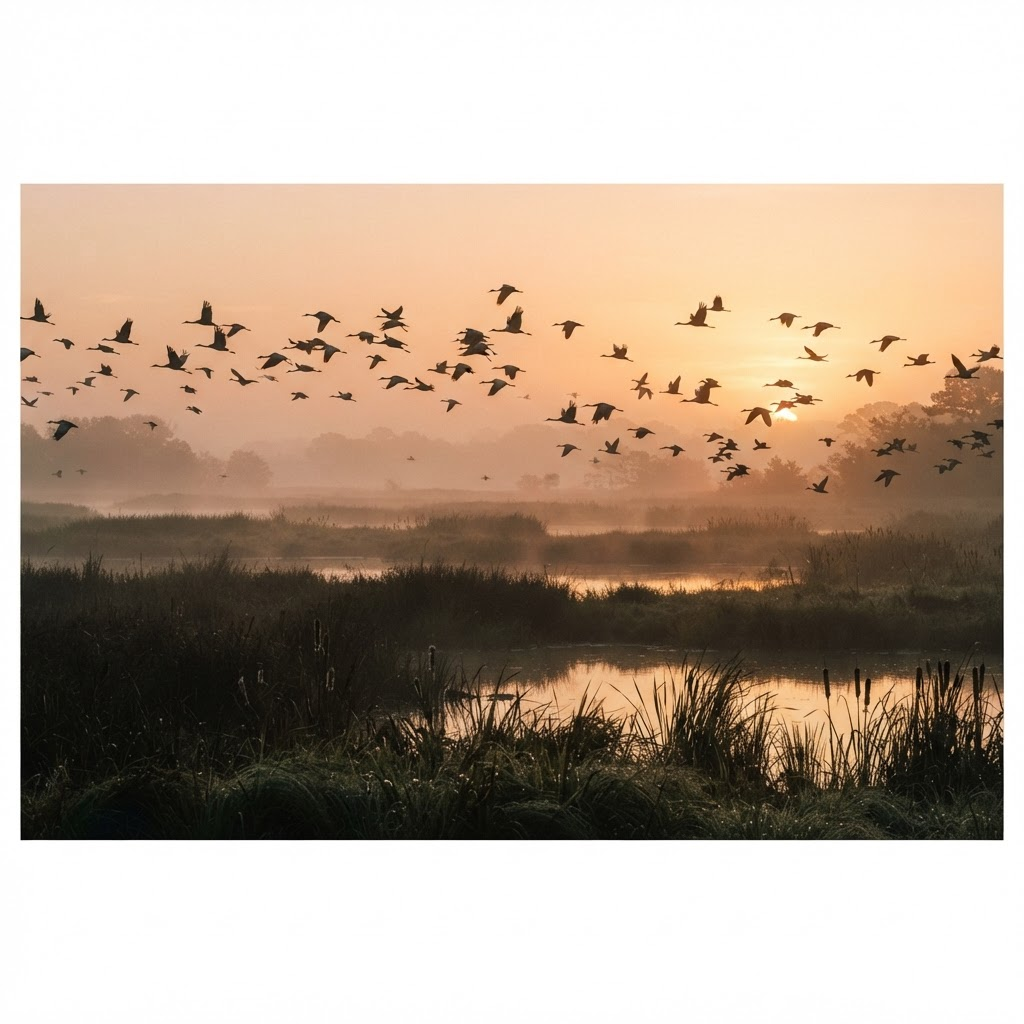
The first birds come with the sun. A handful at first, high and unconvinced, circling twice and peeling off. You cuss them quietly into your coat. Then the wind shifts a half point the way the old-timers said it would, and the next bunch locks up a quarter mile out. White bodies, black wingtips, drifting down like they've been waiting for us all morning. You don't call much then. You just try to breathe quiet and let the field do the talking.
What happened between nine and noon is what you tell in pieces for the rest of the year, each man adding the part the others missed. The birds that committed. The ones that flared at the last second. The shot nobody thought would connect and the one that folded two at once. The way the blue geese mixed in with the snows, darker and meaner-looking, and how they always seemed to hang back a beat longer before deciding.
By the time the shooting slacked and the sun climbed overhead, the grass in front of the blind was full. We laid them out in rows — I won't say how many, because a hunter's number and the honest number are two different animals — snow geese by snow geese, the blue and dark juveniles scattered through the lines like punctuation in a sentence we were going to have to explain to our backs later that night.
There's a moment after a hunt like this that has nothing to do with the birds. You're all standing around the tailgate with flat Dr Peppers and cold breakfast, still in your white shells, and the field is quiet again. The trucks, the trailer, the rows of birds, the blue sky, the treeline — all of it looks like a photograph you didn't take and will spend the drive home trying to describe.
Somebody says, "That's why we come up here." Nobody argues, because there's no argument to make.
Opening day in Canada isn't really about the opener. It's about the leaving — the drive north through towns that still count you by the dust on your fenders, the gas-station coffee that tastes like the border, and the understanding, older than any of us, that a Texas boy will drive a thousand miles for a field full of white wings and a reason to stand still.
The birds are already in the freezer, or they will be by dark. The gear is muddy. The truck smells like a marsh and a hayloft had a falling out. And somewhere in the truck, half-finished, is the sentence every one of us has been turning over since the first flock locked up this morning.
We'll finish it next year. That's the arrangement.